The Mistakes Small Businesses Make With Unified Team Inbox
Santa Cruz, CA 95062

Megan Lyng

Marcus Vidrine III
Your team answers WhatsApp on one phone, Instagram DMs on a laptop, and Messenger somewhere else. Messages get seen twice or not at all, and customers notice the silence before you notice the gap. A unified team inbox should close that gap, not widen it. A fuller comparison of Whatsapp Business API is worth reading alongside this.
This article covers five mistakes small businesses make when adopting a shared inbox, from treating it like a shared email folder to skipping automation and ignoring security. By the end, you will know which channels to consolidate, how to set assignment rules, and what to check before scaling conversations across WhatsApp, Instagram and Messenger.
Small businesses often adopt a unified team inbox expecting instant relief from email overload, but without proper setup, it can quickly become another source of chaos. The promise is simple: one place where every conversation lives, every teammate can see it, and nothing slips through. The reality is messier.
Most teams are juggling channel fragmentation across email, live chat, WhatsApp integration, and social media DMs. When those conversations do not flow into one system, staff end up copying and pasting between tabs, and messages get answered twice or not at all.
Visibility is the other quiet failure. Without assignment rules or ownership, everyone assumes someone else is handling a thread. Missed messages pile up, response time stretches, and customer satisfaction drops before anyone notices the pattern.
Many small business owners believe a shared inbox is simply a group email address that everyone can access, but that assumption leads to missed opportunities and frustrated customers. A shared inbox is a collaborative workspace, not a folder with extra seats.
When teams treat it like a communal mailbox, they skip the structure that makes it useful. Here are the myths that cause the most damage:
Consider a two-person support team fielding the same billing question five times a day. With no canned responses, each reply is typed from scratch. With no assignment rules, both people may answer the same ticket while a refund request waits unnoticed.
These gaps also stall collaboration. Collision detection and internal notes only help if the team actually uses them, and that requires onboarding and training, not just a login. Without that groundwork, a shared inbox becomes another inbox, and the original problem of email overload simply changes address.
Thinking of a unified inbox as merely a shared email folder ignores the distinct nature of each communication channel, leading to mismanaged conversations. A shared inbox for email management and a unified team inbox built for customer support are not the same tool. The first sorts messages. The second routes, tracks, and resolves them across every channel a small business uses.
When teams collapse that distinction, they skip the structure that makes a shared inbox work: assignment rules, internal notes, prioritization, and visibility into who owns what. The result is missed messages, duplicated replies, and conversations that fall through the cracks. Customers notice when a question sent on one channel sits unanswered while the team focuses on another.
Treating every channel as email also distorts expectations around response time. Email tolerates a slower turnaround. Live chat and social media DMs do not. Small businesses that blur these norms train customers to expect silence, which quietly erodes customer satisfaction and invites churn.
Each messaging platform has its own etiquette, features, and limitations. Treating them all the same in a unified inbox can backfire spectacularly. A reply that feels natural on one channel may break the rules, or the mood, on another.
WhatsApp is the clearest example. Business messaging there often relies on template messages for conversations initiated outside an active session, and a 24-hour window typically governs when a business can reply freely. Send a promotional blast outside that window, and the message may not deliver at all. Teams that treat WhatsApp like email learn this the hard way, after a campaign silently fails.
Instagram rewards a visual-first approach. Customers often arrive from a post or story, so context matters. A canned text reply that ignores the product in the photo feels robotic. Messenger leans on quick replies, buttons, and fast back-and-forth exchanges. A slow, formal email-style response there reads as a non-answer.
Ignoring these differences produces predictable failures:
Best practice is to manage each channel on its own terms inside one workspace. Set channel-specific canned responses and templates. Apply assignment rules so the right person handles each inbox. Use tagging and filtering to separate channels, and keep internal notes visible so context travels with the conversation. Collision detection prevents two agents from answering the same DM. Where possible, automation and an SLA per channel keep response time honest across WhatsApp integration, social media DMs, and live chat alike.
None of this requires treating every channel identically. It requires treating each one correctly, then letting one unified team inbox hold the visibility, accountability, and ownership that small business customer service depends on.
Without clear ownership, messages slip through the cracks, and team members waste time stepping on each other's toes. A shared inbox gives everyone visibility, but visibility alone does not create accountability. When every agent can see every conversation, it is easy for each person to assume someone else will handle it.
This is one of the most common mistakes small businesses make when adopting a unified team inbox. The tool is in place, the team is logged in, yet no one owns the outcome of a given conversation. The result is slower response times, frustrated customers, and an internal culture where accountability becomes and difficult to trace.
The fix is not more meetings or stricter supervision. It is a simple set of assignment rules that route each conversation to a specific owner the moment it arrives, so responsibility is never left to chance.
When multiple agents can see all messages but no one is specifically assigned, it's common for two people to answer the same query while others go unanswered. One agent drafts a reply, a second agent sends a slightly different answer, and the customer receives two conflicting messages. That kind of overlap does not just look unprofessional. It signals to the customer that no one is actually in charge.
Concurrently, the opposite problem occurs. A message that looks complex or unfamiliar gets quietly skipped by everyone, and by the time someone notices, the customer has already moved on. Dropped conversations are one of the leading drivers of churn in small business customer support, because silence reads as indifference.
Assignment rules solve both problems at once. Common routing methods include:
Collision detection is especially valuable in a shared inbox, because it prevents the duplicate replies that frustrate customers without requiring agents to constantly ask each other who is taking what.
Consider a small online retailer handling orders, returns, and product questions across email, live chat, and social media DMs. Before routing rules, three agents monitored the same queue and response times stretched out during busy periods. After setting up round-robin assignment with collision detection, each conversation had a clear owner from the first minute. The team reported faster first responses and fewer customer complaints about repeated answers, largely because no message sat unclaimed.
The broader lesson is that a unified team inbox is only as effective as the rules behind it. Ownership, routing, and collision detection turn a shared view of messages into an accountable workflow. Without them, a small business ends up with email overload in a single place instead of several, which is progress in visibility but not in customer service.
Relying solely on manual replies might work for a handful of messages, but as volume grows, it becomes unsustainable and error-prone. Every new channel adds more conversations, and a small team cannot type its way out of that math.
When agents answer the same questions by hand, response time stretches and missed messages pile up. Customers wait, agents burn out, and the shared inbox becomes a source of stress instead of a coordination tool.
Worse, manual replies do not scale with the business. Hiring more agents is one option, but it is slow and expensive. Automation handles the repetitive layer so people can handle the nuanced layer.
A visual bot builder lets you automate repetitive queries without writing code, freeing your team to focus on complex issues. Instead of scripting logic in a text file, you arrange steps on a canvas and connect them like a flowchart.
The biggest wins come from high-volume, low-variance questions. Consider what fills most small business inboxes:
A well-designed bot can resolve many of these routine queries on its own, improving response time for the routine tier. That shift matters because response time is one of the clearest drivers of customer satisfaction.
Canned responses complement bots rather than compete with them. A bot handles the predictable path end to end, while a saved reply gives a human agent a fast, consistent answer when a conversation needs a personal touch. Together they reduce typing and keep tone consistent across the team.
Here is a simple flow you can build in a visual builder:
Keep the first version small. One well-built flow that deflects a single repetitive question is worth more than an ambitious bot that frustrates customers and gets switched off.
If your unified inbox only covers email, you're still juggling multiple apps for WhatsApp, Instagram, and live chat, defeating the purpose of unification. Many small businesses pick a tool based on its email features alone, then discover that customers who reach out on social media or messaging apps sit in a separate queue entirely.
The hidden cost shows up fast. Agents bookmark extra tabs, copy details between systems, and lose track of who replied to whom. What looked like a single shared inbox quietly becomes another silo in the stack, and the original problem of scattered conversations never really goes away.
Before committing to any platform, list every channel your customers actually use, then confirm the tool handles each one natively rather than through awkward workarounds.
Using separate tools for each channel means your team must constantly switch contexts, leading to lost productivity and missed messages. Every switch carries a small tax: refinding the conversation, recalling the customer's history, and reorienting to a different interface. Context switching of this kind tends to erode focus across an entire workday.
Across a full team, those small delays compound. An agent bouncing between several apps may lose a meaningful slice of each day to navigation alone, time that never appears on any report but shows up as slower response time and thinner customer support.
Fragmentation also breaks visibility. When email lives in one system and social media DMs in another, no single dashboard shows the full picture. Managers cannot see total volume, spot bottlenecks, or measure how quickly the team resolves issues. Reporting becomes a manual stitching exercise, and accountability blurs because ownership of a conversation is unclear.
Missed messages hide in the gaps between tools. A customer who emails, then follows up on WhatsApp, may get two disconnected replies or none at all. That inconsistency damages trust and feeds churn.
When evaluating a true multi-channel inbox, look for a few practical criteria:
A tool that meets these tests turns scattered messages into one workflow. One that does not simply relocates the chaos.
As you scale conversations, security and compliance can't be an afterthought, especially when handling sensitive customer data across multiple channels. Small businesses often treat these as enterprise concerns and focus only on features and speed of setup.
That shortcut creates real risk. A shared inbox concentrates customer records, order details, and payment conversations in one place, which makes it a valuable target and a heavier compliance obligation. Meanwhile, unpredictable per-seat and per-message pricing can quietly turn a budget tool into a major monthly expense.
Cost control matters just as much as protection. A platform that looks affordable for a five-person team may become expensive once message volume grows, add-ons stack up, and every new hire needs a paid license. Reviewing security and pricing together, before scaling, prevents both a breach and a billing surprise.
Before you scale, verify that your unified inbox provider offers end-to-end encryption, role-based access, and compliance with regulations like GDPR. These are baseline requirements, not premium extras.
Ask vendors directly about data residency, meaning where your customer conversations are physically stored. If you serve customers in specific regions, local storage rules may apply, and moving data later is far harder than choosing the right setup now.
Audit logs and user permissions deserve equal attention. You need a record of who viewed, edited, or deleted a conversation, plus the ability to limit access by role. A shared inbox without granular permissions means any team member can read every customer record.
Use this checklist when evaluating vendors:
On cost, understand the pricing model before committing. Per-seat pricing scales with headcount, while per-conversation or per-message pricing scales with volume. Ask how add-ons such as WhatsApp integration, social media DMs, or advanced analytics are billed.
Model your costs at your expected team size and message volume, not just today's numbers. A tier that fits a small business now may push you into a higher bracket within months. Confirm whether unused seats can be removed and whether overage charges apply.
Finally, weigh total cost against support quality. The cheapest plan often lacks audit logs, permission controls, or reliable response time during peak periods, and those gaps cost more in churn than the subscription saves.
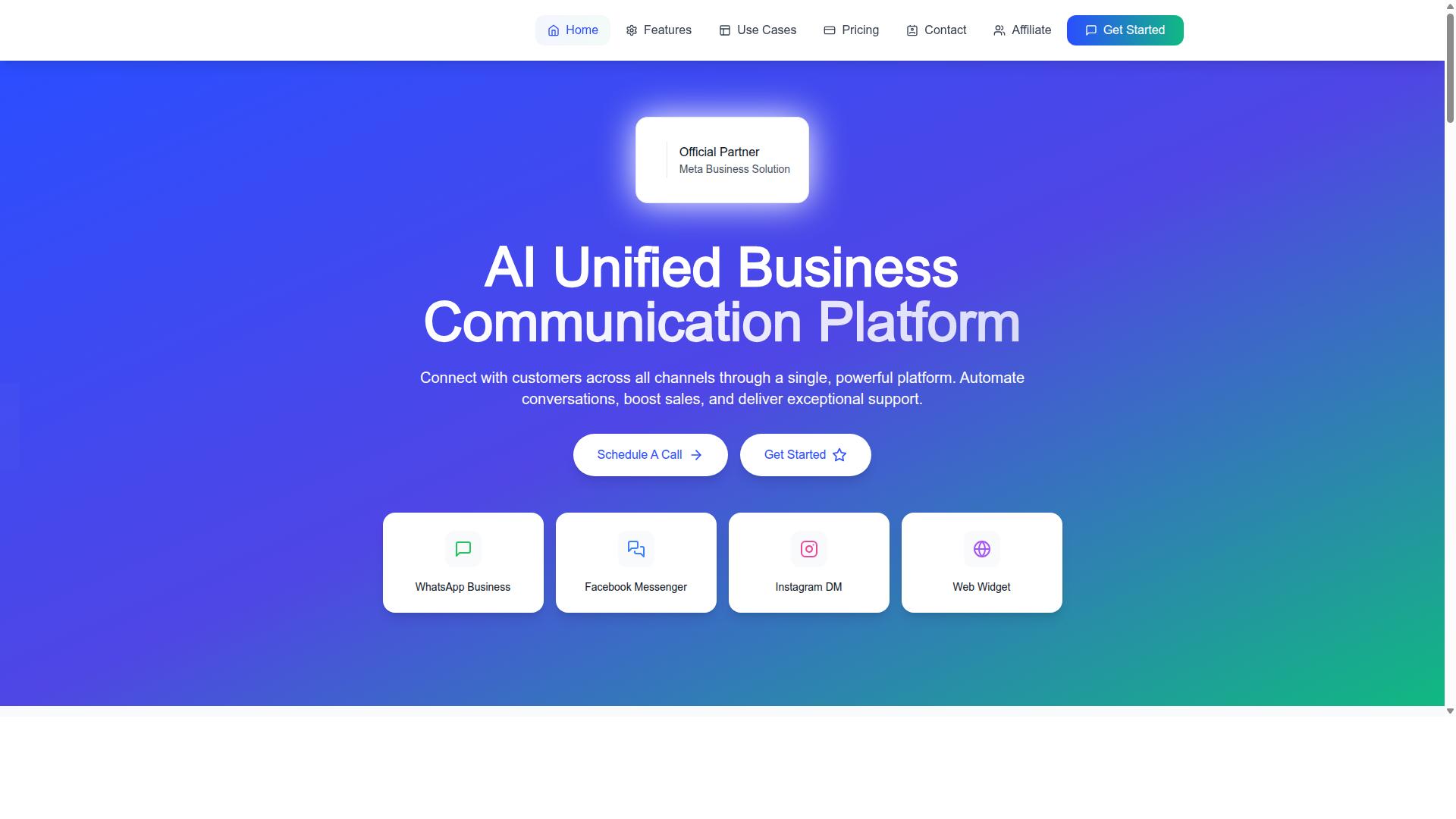
Com.bot is an AI Unified Business Communication Platform that directly tackles the five mistakes small businesses make with unified inboxes. The platform is built by Com Bot AI Limited and operates as an Official Meta Business Partner with direct WhatsApp Business API integration.
Each of those common errors, from channel fragmentation to weak assignment rules, has a practical counter in the platform's design. Instead of stitching together separate tools for chat, social DMs, and payments, small teams work from one place.
The two sections below break down the platform's core capabilities and its pricing structure, so you can judge whether it fits your team's size and budget.
Com.bot brings together WhatsApp, Facebook Messenger, Instagram DM, and Web Widget into a single unified team inbox, eliminating channel fragmentation. Every conversation lands in one queue, so agents stop switching between apps and customers stop falling through the gaps.
Several capabilities map directly onto the mistakes covered earlier in this guide:
The multi-channel support covers WhatsApp, Facebook, and Instagram together, which matters because small business audiences rarely live on one platform. A customer who messages on Instagram and follows up on WhatsApp is still one contact in one thread history.
Smart Chatbots and Payment Collection round out the toolkit, while Tickets.Bot, Calendars.Bot, and Tasks.Bot extend the same ecosystem into ticketing, appointment booking, and task automation. For a small team, that means fewer subscriptions to manage and less context lost between systems.
Com.bot offers transparent pricing tiers designed for small teams, with plans starting at $149 per quarter for the Silver Plan. The structure lets a business start small and add capacity only when the workload demands it.
| Plan | Price | Notes |
|---|---|---|
| Silver | $149 per quarter | Entry tier for small teams |
| Gold | $349 per quarter | Recommended plan |
| Platinum V1 | $2500 per quarter | Highest tier |
Add-ons cost $10 per month each for an additional team member, social channel, external actions (per 5000), bot triggers (per 25000), or ecom store. WhatsApp messaging is billed at actual Meta rates with no markup, which keeps the biggest variable cost predictable as volume grows.
Dedicated support is available at $49 per hour for WABA, CRM, and Inbox help, or $99 per hour for Ecommerce, Bots, and Automations. That pay-as-needed model suits small businesses that want expert help during onboarding without committing to a retainer.
On the setup side, the practical path is to begin with the channels you already use, connect the inbox, and layer in automation once the team is comfortable. Starting with one or two channels limits the adoption shock that causes resistance to change, and role-based access makes it easy to bring new agents in gradually.
Cost control comes from matching the plan to real volume rather than projected volume. A team handling a modest flow of social media DMs and live chat may find Silver sufficient, while heavier operations with payment flows and bulk messaging will get more value from Gold. Reviewing add-on usage each quarter helps avoid paying for channels or triggers the team is not actively using.
Recommended Resources:
Step into the vibrant charm of Pleasure Point and embrace the best of coastal living. Just steps from the ocean, this beautifully remodeled home offers an unbeatable blend of style, comfort, and surfside convenience.
Enjoy high ceilings and an open floor plan bathed in natural light, with walls of windows framing captivating ocean views. Watch the waves and check the surf right from your home. Multiple outdoor showers, surfboard storage, and custom racks make beach life a breeze.
Freshly painted and thoughtfully updated, this flexible home features multiple bedroom suites, ideal for families or guests, along with a spacious back deck and garden beds for the perfect indoor-outdoor lifestyle. The studio ADU with a loft adds incredible versatility—great for guests or rental income.
Eco-conscious touches like solar power enhance this coastal retreat, blending modern sustainability with laid-back beach living.
Don't miss your chance to own this rare gem in one of Santa Cruz's most sought-after neighborhoods.


22956 East Cliff Dr
Share this property on:
Message Sent